




How to Choose Mining Drill Bits for High-Impact Drilling?
Contact Hainaisen
Email: hainaisen@hnsdrillbit.com
Tel: +86 17791389758
Introduction
Selecting the right Mining Drill Bits for high-impact drilling is less about choosing the hardest cutter and more about controlling how the bit interacts with the formation. In hard limestone, granite, abrasive sandstone, fractured rock, or interbedded formations, sudden changes in rock strength can create impact loads that damage cutters, increase vibration, and shorten bit life. The best bit is therefore the one that matches the formation while keeping the cutting structure stable under the expected drilling load.
For high-impact conditions, four questions should be answered before a bit is selected: How hard and abrasive is the formation? How much impact will the cutters experience? How stable can the bit remain at the planned WOB and RPM? And can the hydraulic system keep the cutters clean and cool? Cutter size, cutter count, blade layout, back-rake, bit profile, gauge protection, and hydraulic design should all be considered together.
This approach is especially important when drilling through interbedded or fractured formations. Recent experimental work has shown that sudden changes between soft and hard rock can produce significant changes in depth of cut and trigger strong bit vibration. Higher WOB and rotary speed can further increase the vibration response.
Why High-Impact Formations Damage Drill Bits
Hardness and abrasiveness create different failure mechanisms
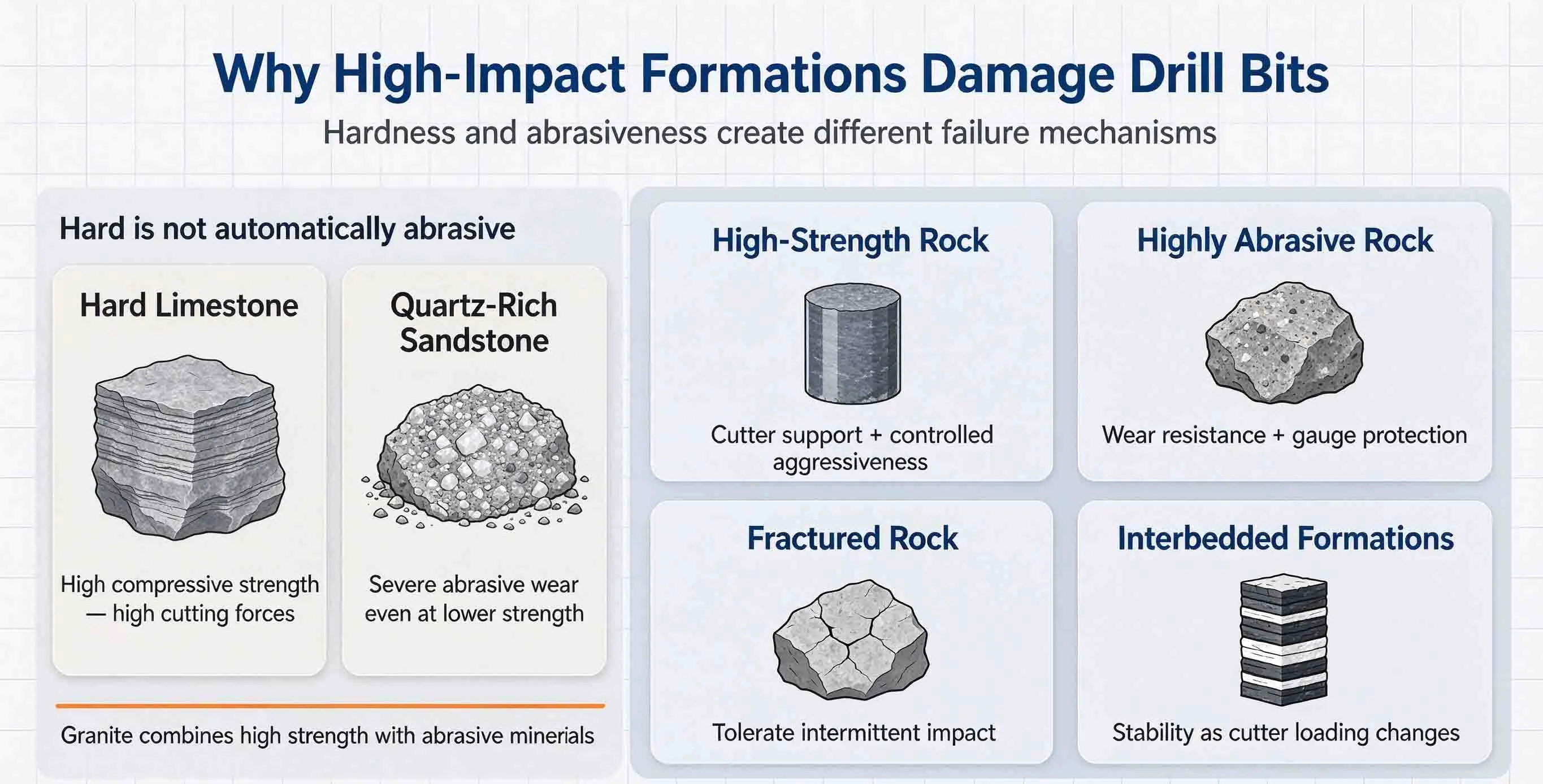
A hard formation is not automatically the same as an abrasive formation.
A dense limestone may impose high cutting forces because of its compressive strength, while quartz-rich sandstone can produce severe abrasive wear even when its compressive strength is lower. Granite and other crystalline rocks can combine high strength with abrasive mineral content, creating a particularly demanding environment for the cutting structure.
Research on PDC cutter wear shows that abrasive and adhesive wear are major wear mechanisms, while rock properties such as hardness, silica content, grain characteristics, and abrasiveness can strongly influence wear rate.
That distinction matters during bit selection:
- High-strength rock requires sufficient cutter support and controlled aggressiveness.
- Highly abrasive rock requires strong wear resistance and effective gauge protection.
- Fractured rock requires a structure capable of tolerating intermittent impact.
- Interbedded formations require stability because cutter loading changes rapidly as the bit crosses different layers.
- Deep or high-temperature wells require additional attention to cutter temperature and cooling.
A bit that is optimized only for ROP in soft rock can therefore perform poorly once it enters a harder interval.
Interbedded formations are particularly demanding
Consider a bit drilling through shale and then suddenly entering a hard limestone stringer. The cutters that were comfortably removing the softer formation can encounter a much larger resistance almost instantaneously.
The result can be a rapid change in depth of cut, torque, and axial or lateral loading.
Experimental research published in Geoenergy Science and Engineering found that sudden transitions between different rock types can cause strong changes in PDC bit vibration. The study also found that the impact response is closely related to changes in depth of cut when the bit crosses an interlayer.
This explains why some bits show excellent ROP through the softer part of an interval but suffer severe cutter damage at the hard stringers.
The problem is not necessarily insufficient diamond quality. The bit may simply be too aggressive or insufficiently stable for the formation transition.
Bit stability matters as much as cutter strength
High-impact drilling frequently becomes a vibration problem.
Axial vibration can produce bit bounce. Torsional vibration can create stick-slip behavior. Lateral vibration can lead to bit whirl. These modes can interact, causing individual cutters to experience loads far above the average drilling load.
Classic SPE research on PDC bit whirl demonstrated that lateral instability can cause cutters to move sideways and backward relative to the intended cutting path. The associated impact loading can chip cutters and accelerate wear.
For directional and horizontal drilling, stability becomes even more important because the BHA, well trajectory, formation heterogeneity, and bit-rock interaction can all influence the cutting path.
This is why a durable cutter cannot compensate for an unstable bit design.
How to Select the Right Bit and Operating Window
Start with the formation, not the bit catalog
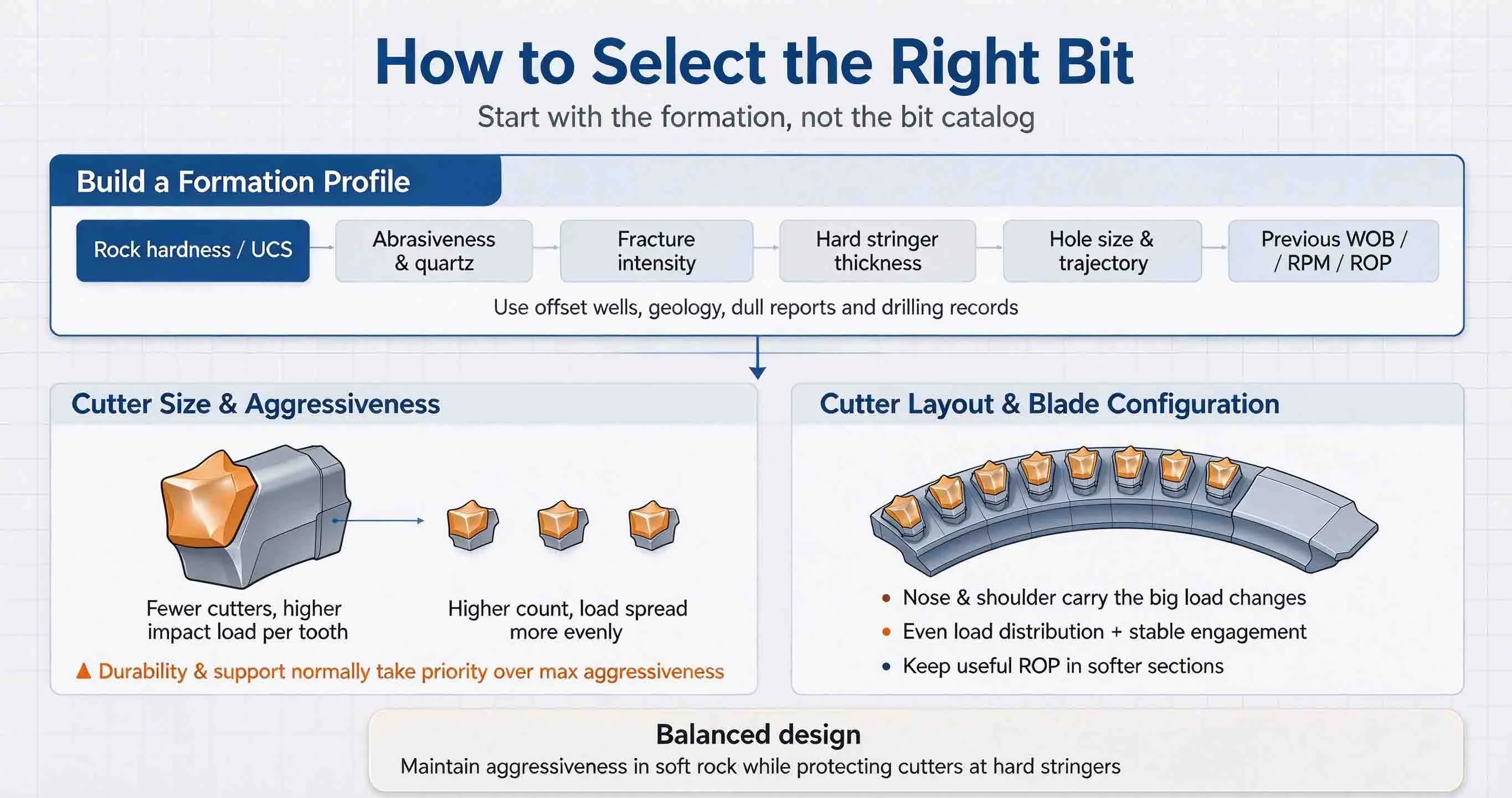
Before choosing a bit, build a practical formation profile from offset wells, geological information, previous dull reports, and drilling records.
The most useful information includes:
- Rock hardness or compressive strength
- Abrasiveness and quartz content
- Fracture intensity
- Thickness of hard stringers
- Expected formation transitions
- Hole size and well trajectory
- Previous WOB, RPM, torque, flow rate, and ROP
- Previous cutter and gauge wear
If an offset bit failed only after entering a specific hard layer, that information is more valuable than simply recording the total footage.
Select cutter size and aggressiveness according to impact risk
Cutter size is one of the most important design decisions.
Larger cutters can provide high cutting efficiency and more diamond volume, but they may also concentrate impact loads on fewer cutting elements. Smaller cutters allow a higher cutter count and can distribute the cutting load more evenly.
For hard or highly variable formations, cutter durability and support should normally take priority over maximum aggressiveness.
This does not mean that small cutters are always better. In an interbedded interval containing long sections of softer rock, a highly conservative cutting structure may sacrifice too much ROP. The better solution can be a balanced design that maintains adequate aggressiveness in the softer section while protecting the cutters when hard stringers appear.
Published IADC/SPE work on interbedded formations has discussed this exact trade-off: large cutters can deliver strong penetration in softer formations, but they can be more susceptible to impact damage when encountering harder stringers, making bit stability particularly important.
Pay attention to cutter layout and blade configuration
Cutter count alone does not determine performance.
The radial position of each cutter, blade profile, cutter exposure, back-rake angle, and distribution of cutting load all influence how the bit behaves.
For high-impact drilling, the nose and shoulder regions deserve particular attention because they can experience substantial changes in loading as the bit moves across the formation.
A well-designed cutting structure should:
- Distribute impact loads effectively
- Maintain sufficient cutter support
- Avoid excessive local exposure
- Provide stable engagement with the rock
- Maintain useful cutting efficiency as wear develops
Modern fixed-cutter bit development increasingly uses application-specific cutter geometries and layouts rather than relying on one standard cutting structure for every formation. Baker Hughes, for example, describes different cutter technologies for interbedded, hard, and abrasive formations and emphasizes matching cutter placement to the drilling application.
Do not overlook the hydraulic design
Cutter durability is also influenced by what happens after the rock is cut.
If cuttings are not removed efficiently, they can remain around the cutters, increasing regrinding, friction, and heat. In abrasive formations, poor cleaning can make an already difficult wear problem worse.
Hydraulic design should therefore consider:
- Nozzle position
- Flow distribution
- Junk-slot area
- Cutter cleaning
- Cooling
- Expected mud properties
- Available pump rate
Research on cutter temperature and wear has shown that controlling cutter temperature through adequate cooling is important when drilling hard formations.
For a high-impact application, the hydraulic system should not be treated as an afterthought. The cutting structure and hydraulic system need to work together.
Protect the gauge in abrasive formations
Gauge wear can gradually change the way a bit interacts with the wellbore.
When the gauge becomes worn, lateral stability and hole quality can deteriorate. Additional vibration may then develop, creating a cycle in which gauge wear contributes to further cutter damage.
For abrasive formations, the design review should therefore include:
- Gauge protection
- Wear-resistant materials
- Appropriate gauge length
- Shoulder protection
- Stable outer cutter placement
The objective is not simply maximum hardness. The gauge needs to remain dimensionally stable for the expected formation and drilling interval.
Establish a controlled WOB and RPM window
A bit designed for high impact still needs the right operating conditions.
Increasing WOB does not automatically increase productive ROP. Once the cutters are taking an excessive depth of cut, additional weight can increase cutting forces, vibration, torque, and wear faster than it increases penetration.
RPM has a similar trade-off. Too little rotary speed can reduce drilling efficiency, while excessive speed can increase friction, heat, and dynamic instability depending on the formation and bit design.
A practical operating strategy is to:
- Start within the manufacturer's recommended WOB and RPM range.
- Increase WOB gradually while watching ROP and torque.
- Monitor torque fluctuations rather than only average torque.
- Watch for vibration or stick-slip behavior.
- Maintain sufficient flow for hole cleaning and cutter cooling.
- Reduce aggressiveness when entering known hard stringers.
Research on worn PDC cutters also shows that cutter wear increases cutting force and reduces cutting efficiency, meaning that forcing additional WOB onto an increasingly worn cutter structure can become progressively less efficient.
Use the dull condition to improve the next bit
The final bit condition should be treated as engineering feedback.
If the bit shows:
Localized chipping:
Investigate impact loading, cutter exposure, vibration, and formation transitions.
Uniform abrasive wear:
Review cutter wear resistance, exposure, formation abrasiveness, and operating conditions.
Heavy shoulder wear:
Review cutter placement, bit profile, gauge behavior, and directional loading.
Gauge wear:
Review formation abrasiveness, gauge protection, and lateral stability.
Severe thermal damage:
Review RPM, cutter engagement, flow rate, hydraulic cleaning, and cutter-rock friction.
This diagnostic approach is more useful than simply moving to a "stronger" bit after every failure.
Practical Case: Adjusting a Bit for an Interbedded Hard-Rock Section
An anonymous drilling contractor was working through an interval containing relatively drillable rock with intermittent hard and abrasive stringers. The existing bit delivered acceptable penetration in the softer sections, but torque became unstable when the bit entered the harder layers. The dull bit showed localized cutter damage rather than uniform wear across the entire cutting structure.
The drilling team did not simply increase WOB on the next run.
Instead, the formation sequence and previous dull condition were reviewed together. The next bit was specified with a more impact-tolerant cutter arrangement, stronger support in high-load areas, and a hydraulic configuration intended to maintain cutter cleaning. The operating procedure was also adjusted so that WOB was increased more gradually when entering the harder interval.
The practical result was a more controlled drilling response and a more predictable wear pattern.
No single bit specification should be assumed to produce the same result in every field. The important lesson is that bit design, formation response, and drilling parameters have to be evaluated as one system.
This principle is consistent with recent industry work on PDC cutter technologies for challenging and interbedded drilling applications, where cutter technology and bit design are optimized around both performance and durability.
How Hainaisen Can Support High-Impact Bit Selection
Hainaisen recommends selecting a bit according to the actual formation and drilling objective rather than relying on a standard model for every application.
For demanding rock conditions, the technical discussion should cover formation hardness, abrasiveness, impact potential, cutter type, cutter size, blade configuration, cutter layout, hydraulic requirements, gauge protection, and expected WOB/RPM conditions.
Hainaisen's approach combines stable product quality, strict quality control, PDC cutter technology, and formation-based recommendations. Where a standard design is not suitable, customized cutter layouts, blade configurations, and other bit features can be considered according to the customer's hole conditions and drilling requirements.
This approach can be useful for different applications, including mining, water well, directional, and other hard-rock drilling projects. The recommendation can be refined from information such as hole diameter, formation type, drilling depth, rig capability, previous bit performance, and expected operating parameters.
For overseas customers, responsive technical communication is also important. Hainaisen supports international customers with professional technical assistance, customized bit design, export experience, and application-specific recommendations, helping purchasing teams and drilling contractors move from a general bit requirement to a more practical drilling specification.
The goal is straightforward: maintain useful ROP while controlling impact damage, cutter wear, vibration, and unnecessary trips.
FAQ
What type of PDC bit is best for high-impact drilling?
A suitable bit normally combines impact-resistant cutters, strong cutter support, stable blade geometry, appropriate cutter density, and effective gauge protection. The exact configuration depends on the formation and drilling parameters.
How do I choose a PDC bit for hard and abrasive rock?
Evaluate both formation strength and abrasiveness. Then match cutter size, cutter count, exposure, back-rake, blade configuration, gauge protection, and hydraulic capacity to the expected conditions.
Are larger cutters suitable for interbedded formations?
They can be, particularly when the interval contains significant softer sections where higher aggressiveness is valuable. However, larger cutters can experience higher impact loading at hard stringers, so bit stability and cutter support become especially important.
What drilling parameters have the biggest effect on cutter life?
WOB, RPM, torque, flow rate, and drilling stability all matter. Excessive WOB can increase depth of cut and impact loading, while unsuitable RPM or insufficient flow can contribute to vibration, friction, and thermal stress.
How can I reduce cutter damage when entering a hard formation?
Avoid abrupt increases in WOB. Monitor torque and vibration, maintain effective hydraulic cleaning, and use a bit designed for the expected formation transition. A more impact-tolerant cutter structure may also be appropriate.
Can Hainaisen customize a bit for a specific formation?
Yes. Hainaisen can discuss formation-based cutter selection, blade configuration, cutter layout, gauge protection, and other design requirements according to the customer's drilling conditions and application.
About the Author
Michael Carter is a drilling technology writer and technical consultant specializing in drill bit selection, PDC cutting technology, formation-related drilling challenges, and practical bit performance. His work focuses on translating formation characteristics and field drilling data into practical recommendations for mining, oil and gas, and water well applications.
References
- International Association of Drilling Contractors (IADC), Back to Basics: Drillability. Industry guidance covering formation drillability and PDC cutter design considerations.
IADC Technical Guidance
- Brett, J. F., Warren, T. M., & Behr, S. M., “Bit Whirl: A New Theory of PDC Bit Failure,” SPE Drilling Engineering, Vol. 5, No. 4, 1990, pp. 275–281. The paper examines lateral instability, impact loading, cutter chipping, bit life, and ROP.
- Wang, C., Li, S., & Zhang, L., “Evaluation of Rock Abrasiveness Class Based on the Wear Mechanisms of PDC Cutters,” Journal of Petroleum Science and Engineering, Vol. 174, 2019, pp. 959–967. The study analyzes rock abrasiveness and abrasive/adhesive wear mechanisms affecting PDC cutters.
- Mazen, A. Z., Mujtaba, I. M., Hassanpour, A., & Rahmanian, N., “Mathematical Modelling of Performance and Wear Prediction of PDC Drill Bits: Impact of Bit Profile, Bit Hydraulic, and Rock Strength,” Journal of Petroleum Science and Engineering, Vol. 188, 2020. The study considers the relationships between rock strength, bit profile, hydraulics, cutter wear, and drilling performance.
- Liu, W., Deng, H., Zhu, X., & Deng, K., “The PDC Cutter-Rock Interaction Behavior in Rock Cutting: A Review,” Geoenergy Science and Engineering, 2023. The review discusses MSE, cutter-rock interaction, cutting parameters, cutter wear, and rock-breaking mechanisms.
- Zhang, J., Cui, M., Wang, Q., et al., “Experimental Study on Rock Drilling Vibration of PDC Bit in Interbedded Formations,” Geoenergy Science and Engineering, Vol. 244, 2025. The research investigates vibration caused by sudden changes between different rock layers and the effects of WOB and rotary speed.
- Johnson, S. C., “A New Method of Producing Laterally Stable PDC Drill Bits,” SPE Drilling & Completion, Vol. 23, No. 3, 2008, pp. 314–324. The paper examines lateral stability and approaches for reducing bit whirl.
- SLB, Defining Bits. Technical overview of fixed-cutter bit construction, PDC bit bodies, cutter/blade architecture, and applications in different formations.
- Baker Hughes, Fixed Cutter PDC Drill Bits. Industry information covering application-specific cutter technologies, interbedded formations, hard and abrasive formations, cutter placement, and bit stability.