




PDC Drill Bit vs. Tricone Roller Cone: Which Is Right for Your Project?
Contact Hainaisen
Email: hainaisen@hnsdrillbit.com
Tel: +86 17791389758
Choosing between a PDC drill bit and a tricone roller cone bit can significantly affect drilling efficiency, operating costs, and overall well performance. For contractors comparing a PDC solution with a Rock Roller Drill Bit, the decision should be based on formation characteristics, drilling conditions, equipment capabilities, and the expected footage of each bit run.
A PDC bit uses fixed polycrystalline diamond compact cutters to shear rock continuously, while a tricone bit relies on three rotating cones equipped with milled teeth or tungsten carbide inserts to crush and chip the formation.
For relatively consistent shale, sandstone, and many limestone formations, a properly engineered PDC bit is often the more productive option. Tricone bits remain valuable in highly variable formations, fractured rock, and applications where their crushing action offers practical advantages.
1. Understanding the Technical Differences Between PDC and Tricone Bits
How PDC Drill Bits Break Rock
PDC Bits use synthetic diamond cutting elements bonded to tungsten carbide substrates. These cutters are mounted on fixed blades and remove rock through a shearing mechanism.
Instead of repeatedly striking the formation, the cutters scrape and shear material away as the bit rotates. This cutting action can produce high rates of penetration when cutter geometry, formation properties, and operating parameters are properly matched.
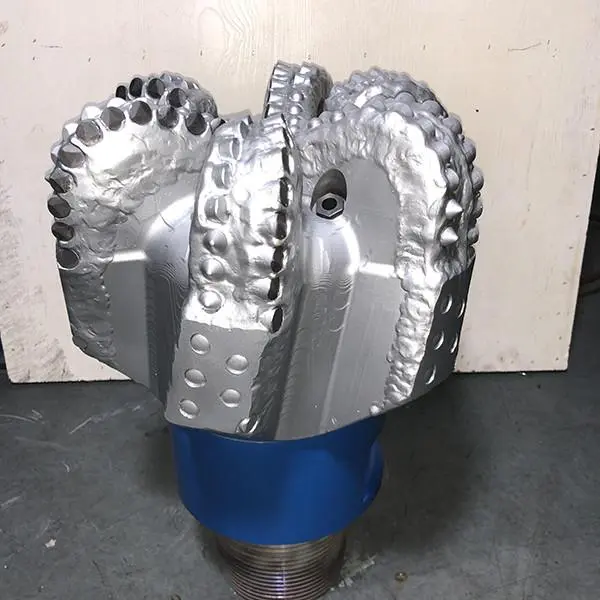
PDC fixed-cutter drill bit used in oil and gas drilling.
Common applications include:
- Shale formations: Efficient shearing of relatively homogeneous shale.
- Sandstone: Good wear resistance with suitable cutter grades.
- Limestone: Effective drilling in stable carbonate formations.
- Directional and horizontal wells: Consistent cutting action and reduced mechanical complexity.
One major advantage is the absence of moving cutting structures. There are no cone bearings or rotating cone seals to fail. However, PDC cutters remain vulnerable to excessive impact, thermal damage, abrasion, and vibration.
How Tricone Roller Cone Bits Work
A tricone bit has three independently rotating cones. As the drill string turns, the cones rotate against the formation, and their teeth or inserts crush, indent, and chip the rock.
The cutting structure varies according to the intended application:
- Milled-tooth tricone bits: Generally used in softer formations.
- Tungsten carbide insert (TCI) tricone bits: Designed for medium-hard to hard formations.
- Specialized hard-formation designs: Use appropriate insert geometries and bearing systems.
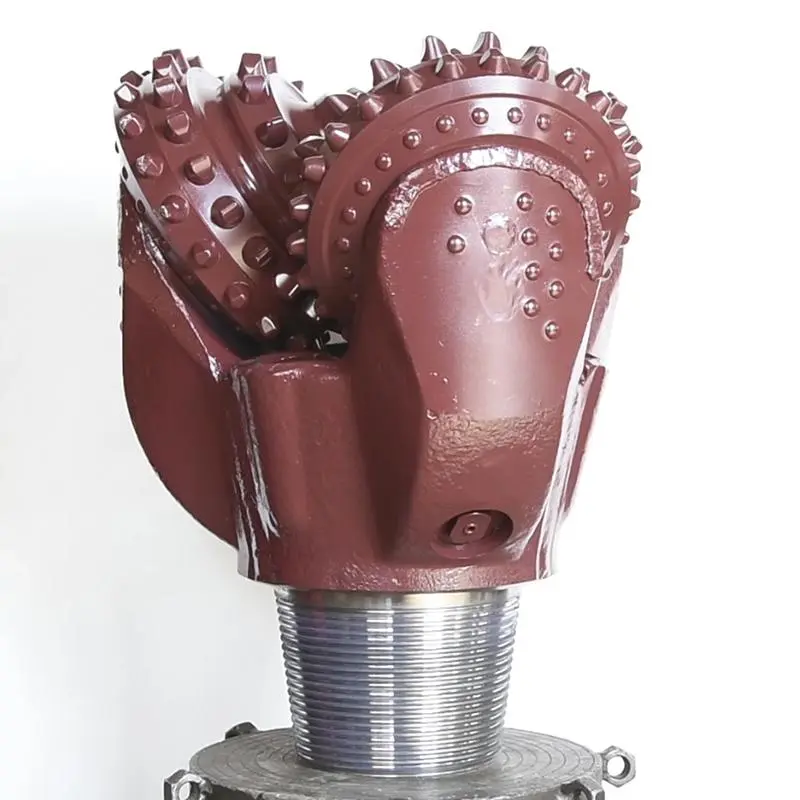
Three-cone tungsten carbide insert roller cone drill bit.
A tricone can be particularly useful when the formation contains alternating hard and soft layers, fractured sections, or irregular rock structures. Its crushing mechanism provides a different response to rock failure compared with the continuous shearing action of a PDC bit.
Key Differences at a Glance
Selection factor | PDC drill bit | Tricone roller cone bit |
|---|---|---|
Rock-breaking mechanism | Continuous shearing | Crushing and chipping |
Cutting structure | Fixed diamond cutters | Three rotating cones |
Moving components | None in cutting structure | Bearings and rotating cones |
Typical strength | High efficiency in suitable formations | Adaptability across different formations |
Drilling speed | Often higher in compatible formations | Depends on tooth design and formation |
Maintenance concerns | Cutter wear and body damage | Bearings, seals, cones, and teeth |
The important distinction is formation compatibility, not simply which bit drills faster.
2. How to Choose the Right Drill Bit for Different Formations
Formation Hardness and Abrasiveness
Formation hardness is an important starting point, but it should never be considered independently of abrasiveness and rock structure.
A relatively soft shale may be drilled efficiently with an aggressive PDC design featuring larger cutters and fewer blades. A harder limestone formation may require smaller cutters, increased cutter density, stronger cutter support, and a more conservative cutting profile.
For abrasive sandstone containing significant quartz content, cutter wear becomes a major concern. The selection should consider diamond-table quality, cutter geometry, exposure, and expected thermal and mechanical loading.
For a Rock Roller Drill Bit, the corresponding selection process involves choosing the appropriate tooth or tungsten carbide insert structure, bearing configuration, and formation classification.
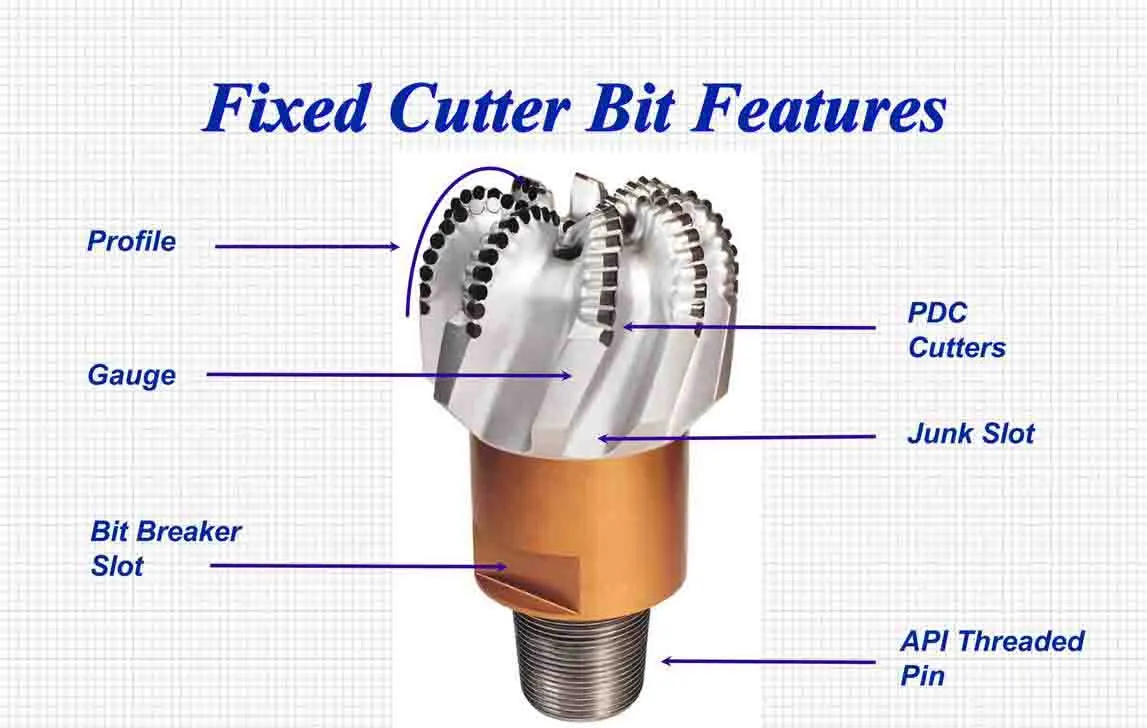
Fixed-cutter drill bit structure and important design features.
A practical selection guide is:
Formation condition | Recommended starting point | Main consideration |
|---|---|---|
Soft, homogeneous shale | PDC | High ROP |
Medium-hard sandstone | PDC or TCI tricone | Abrasiveness |
Stable limestone | PDC | Cutter impact resistance |
Highly fractured limestone | TCI tricone or application-specific PDC | Impact loading |
Hard, abrasive sandstone | Heavy-set PDC or specialized TCI | Wear resistance |
Interbedded formations | PDC or tricone | Formation transitions |
These are general selection guidelines rather than fixed rules. Actual bit performance depends on compressive strength, fracture density, abrasiveness, drilling fluid, and operating conditions.
WOB, RPM, Torque, and Hydraulic Design
Even a well-designed bit can perform poorly when drilling parameters are unsuitable.
Weight on Bit (WOB) determines how much axial force is applied to the formation. PDC cutters need sufficient loading to penetrate and shear rock, but excessive WOB can increase torque, induce vibration, and accelerate cutter damage.
Rotary Speed (RPM) affects cutting frequency and drilling response. PDC bits can often operate at relatively high rotary speeds in suitable formations. Tricone operating speeds must account for cone rotation, bearing limitations, and the selected cutting structure.
Other important factors include:
- Torque: Sudden fluctuations may indicate stick-slip or changing formation conditions.
- Flow rate: Removes cuttings and helps control bit temperature.
- Hydraulic design: Supports effective bottom-hole cleaning.
- Gauge protection: Helps maintain hole diameter.
- Bit stability: Reduces vibration and improves drilling consistency.
- ROP: Should be evaluated alongside bit life and total drilling cost.
For directional and horizontal drilling, torque management and toolface control deserve particular attention. An overly aggressive PDC design may generate unstable torque in interbedded formations. A more balanced cutter layout can improve drilling behavior.
An Industry Example: Drilling Through Interbedded Formations
Consider a drilling contractor working on an onshore oil and gas project in the Middle East. The planned interval contains shale, medium-hard sandstone, and occasional limestone stringers.
The contractor initially selects a conventional PDC bit based on its expected penetration rate in shale. During drilling, however, the bit encounters repeated changes in formation hardness. Torque fluctuations become more noticeable, and the cutters experience increased impact loading.
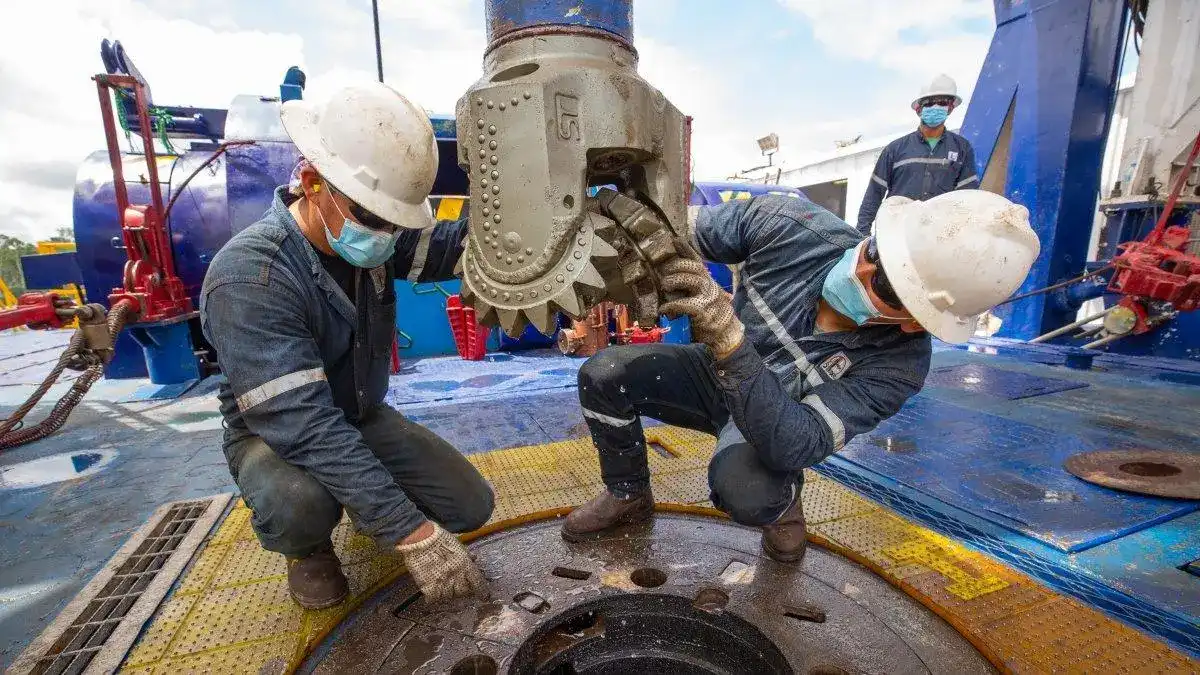
Oilfield drilling personnel handling drilling equipment on a rig floor.
Rather than simply increasing WOB to recover penetration rate, the drilling team reviews the formation sequence and drilling records.
The revised approach includes:
- Selecting a more impact-resistant PDC cutter configuration.
- Adjusting cutter density to improve load distribution.
- Reviewing blade geometry to balance cutting efficiency and stability.
- Optimizing WOB and RPM to reduce excessive torque fluctuations.
- Checking nozzle arrangements to maintain effective cuttings removal.
If severe formation transitions continue to cause instability, the contractor may also evaluate a tricone or hybrid design for the affected interval.
The practical lesson is straightforward: the best bit is not necessarily the most aggressive one. It is the bit that maintains stable performance across the actual formation sequence.
No universal WOB or RPM setting should be applied to every project. Operating parameters must be established using bit specifications, offset well data, and real-time drilling conditions.
3. Improving Drilling Performance with the Right Bit Design from Hainaisen
Why Customized PDC Bit Design Matters
Selecting a drill bit should involve more than matching its diameter to the borehole. Cutter technology, blade configuration, bit profile, hydraulic design, and gauge protection all influence performance.
Hainaisen provides PDC drilling solutions for oil and gas drilling, mining, and water well applications. Its product selection and engineering recommendations can be tailored to different formation conditions and drilling requirements.
When evaluating a PDC solution, several design considerations deserve attention:
- PDC cutter technology: Cutter size, diamond-table characteristics, wear resistance, and impact resistance.
- Blade configuration: Three-blade, four-blade, five-blade, and other configurations.
- Cutter layout: Proper positioning helps distribute drilling loads.
- Hydraulic configuration: Nozzle placement and fluid-channel design support cooling and cuttings evacuation.
- Gauge protection: Appropriate structures help maintain hole diameter.
When Should You Choose a PDC Bit from Hainaisen?
For projects involving relatively consistent shale, sandstone, and limestone, a suitable Rock Roller Drill Bit alternative may be a customized PDC design that better matches the formation and drilling system.
Hainaisen can assist customers with evaluating:
- Formation hardness and abrasiveness.
- Expected drilling depth and well trajectory.
- Required bit diameter and connection specifications.
- Cutter size, grade, and placement.
- Blade number and bit profile.
- Drilling fluid and hydraulic requirements.
- Expected WOB, RPM, and operating conditions.
The company emphasizes stable product quality, strict quality control, and application-oriented PDC cutter selection. Customized bit design helps customers avoid relying on a standard configuration when their formation conditions require a more specific approach.
For overseas drilling contractors and drilling equipment distributors, Hainaisen supports international customers with product selection assistance, customized requirements, export experience, and responsive communication.
The objective is not to recommend a PDC bit for every drilling operation. Where a tricone remains the more suitable choice, that should be recognized during the selection process.
Comparing Total Cost Rather Than Purchase Price
A lower initial bit price does not necessarily translate into lower drilling costs.
When comparing PDC and tricone options, contractors should consider:
- Cost per drilled meter or foot.
- Average ROP under comparable conditions.
- Total footage achieved per bit run.
- Tripping time and replacement frequency.
- Drilling downtime.
- Cutter, bearing, and seal failure risks.
- Hole quality and directional control.
The final decision should be based on total cost per foot, not simply the purchase price or advertised penetration rate.
If you are planning an oil and gas, mining, or water well drilling project, Hainaisen can help evaluate your formation conditions and recommend a suitable PDC bit configuration.
FAQ
1. Is a PDC drill bit better than a tricone bit?
Not in every situation. PDC bits generally offer higher drilling efficiency in compatible formations such as shale and relatively uniform sandstone. Tricone bits can be more suitable for fractured, highly variable, or impact-intensive formations.
2. Can PDC bits drill hard rock formations?
Yes. Modern PDC technology can handle many medium-hard and hard formations. Cutter grade, density, diamond-table properties, and bit structure must match the expected formation.
3. When should I use a tricone roller cone bit instead of a PDC bit?
A tricone is worth considering when drilling through highly fractured formations, frequent hard and soft transitions, or sections where impact loading makes conventional PDC cutting structures difficult to maintain.
4. What factors have the greatest effect on PDC bit life?
The main factors include formation hardness, abrasiveness, cutter quality, WOB, RPM, drilling vibration, torque fluctuations, and hydraulic cleaning.
5. Can Hainaisen customize PDC drill bits for different formations?
Yes. Hainaisen can discuss customized PDC bit configurations based on formation conditions, bit diameter, cutter specifications, blade configuration, and application requirements.
6. How can I reduce drilling costs when choosing between PDC and tricone bits?
Compare cost per drilled foot or meter, ROP, footage per run, tripping time, maintenance requirements, and drilling stability.
About the Author
Michael Anderson is a drilling technology writer and industry consultant specializing in fixed-cutter and roller cone drilling systems. His professional interests include PDC cutter performance, drill bit design optimization, formation evaluation, and drilling efficiency across oil and gas, mining, and water well applications.
References
1. Society of Petroleum Engineers (SPE) – Pessier, R., and Damschen, M. (2011). Hybrid Bits Offer Distinct Advantages in Selected Roller-Cone and PDC-Bit Applications. SPE Drilling & Completion. https://doi.org/10.2118/128741-PA
2. Society of Petroleum Engineers (SPE) – New PDC Design Process Solves Challenging Directional Application in Abu Dhabi Onshore Fields. https://doi.org/10.2118/79796-MS
3. Society of Petroleum Engineers (SPE) – Introduction to Roller-Cone and Polycrystalline Diamond Drill Bits. https://doi.org/10.2118/9781555631147-ch05
4. SLB – Defining Bits. https://www.slb.com/resource-library/oilfield-review/defining-series/defining-bits
5. International Association of Drilling Contractors (IADC). https://iadc.org/