




Maximizing Drilling Efficiency: How Custom Bit Design Saves Rig Time Costs
Contact Hainaisen
Email: hainaisen@hnsdrillbit.com
Tel: +86 17791389758
A properly engineered 6-Blade PDC Drill Bit can help reduce drilling time by balancing cutting efficiency, borehole stability, cutter durability, and hydraulic performance. However, adding blades alone does not guarantee faster drilling. The best design depends on formation hardness, abrasiveness, well trajectory, available drilling power, and the operating conditions downhole. A bit that performs well in a uniform shale interval may struggle in abrasive sandstone or alternating limestone and shale.
For drilling contractors, the real objective is to reduce the total cost of drilling a section, not simply to achieve the highest instantaneous rate of penetration (ROP). Frequent bit trips, premature cutter wear, poor hole cleaning, excessive torque, and time spent correcting directional deviations can quickly eliminate the financial benefit of a high initial ROP.
Custom bit design helps address these problems before the bit reaches the well. By matching cutter grades, blade geometry, cutter placement, hydraulic configuration, and gauge protection to the expected formation, operators can improve footage per run and reduce nonproductive time. The result is a more predictable drilling process and better control over overall rig time costs.
1. Why Standard Bit Designs Can Increase Drilling Time and Operating Costs
Formation conditions determine the actual drilling challenge
Rock properties have a direct influence on how a PDC bit cuts, wears, and responds to drilling loads. Formation hardness, compressive strength, abrasiveness, and geological variability should therefore be evaluated before selecting the bit configuration.
Different formations create different failure mechanisms:
- Soft shale: Large cuttings and sticky clay can accumulate around the cutters and blades, reducing cutting efficiency and obstructing fluid circulation.
- Medium-hard limestone: Uneven rock strength can cause fluctuating torque and vibration, especially when the bit encounters harder streaks.
- Abrasive sandstone: Hard mineral grains gradually wear the diamond cutting edges, reducing penetration efficiency and shortening the useful run.
- Interbedded formations: Repeated transitions between soft and hard layers can create impact loading, unstable torque, and uneven cutter wear.
- Hard, high-compressive-strength rock: Excessive cutter loading may cause chipping, impact damage, or inefficient shearing if the cutter geometry and operating parameters are poorly matched.
The problem becomes more complicated in directional and horizontal wells. A bit must remove rock efficiently while maintaining a stable response to changes in tool-face orientation, formation boundaries, and downhole torque.
A design optimized only for maximum penetration may produce aggressive cutting action but insufficient stability. Conversely, a highly conservative design may remain durable while drilling too slowly to meet the project's cost targets.
The engineering objective is to find the right balance between ROP, durability, directional response, and borehole quality.

Sandstone layers illustrate the geological variability that can influence cutter wear and drilling performance. Photo: Jonathan Wilkins, Wikimedia Commons, CC BY-SA 3.0.
Why drilling time is more expensive than bit price
The purchase price of a drill bit represents only one part of its operating cost. Every additional trip consumes rig time and may require the removal and replacement of a substantial portion of the drill string.
For example, premature cutter failure can force a trip before the planned section is completed. Once the bit is replaced, the crew must run back into the hole, re-establish bottom conditions, and resume drilling. Depending on the well depth and operational circumstances, this interruption can be considerably more expensive than the difference between standard and customized tooling.
Other hidden costs include:
- Reduced ROP caused by worn cutters or inefficient cutter exposure.
- Additional circulation time when cuttings removal is inadequate.
- Reaming or corrective operations caused by poor gauge retention.
- Increased motor or rotary-system loading from excessive torque.
- Lost directional drilling time when the bit responds poorly to steering commands.
Technical literature from the Society of Petroleum Engineers has discussed how cutter wear, frictional heat, and drilling conditions influence PDC bit performance. Research on drilling optimization also demonstrates that WOB, RPM, and hydraulics must be considered together rather than adjusted independently.
The practical lesson is straightforward: bit selection should be evaluated against total drilling performance, including footage per run, trip frequency, and time spent maintaining the hole—not just the initial purchase price.
2. How Custom Bit Design Improves ROP, Stability, and Bit Life
Blade configuration and cutter layout
Blade count affects how cutting loads are distributed across the bit and how much space remains for fluid channels and cuttings evacuation. A six-blade configuration can provide a useful balance between cutter support, stability, and cutting efficiency in suitable formations.
Nevertheless, more blades do not automatically mean a longer bit life or a higher ROP. Additional blades may increase the number of available cutting structures, but they can also reduce the open space available for fluid flow and cuttings removal if the design is not properly engineered.
A 6-Blade PDC Drill Bit may be appropriate when the application requires a stable cutting structure, controlled cutter loading, and dependable gauge performance. Its suitability should be confirmed against the rock type, hole size, drilling system, and target operating parameters.
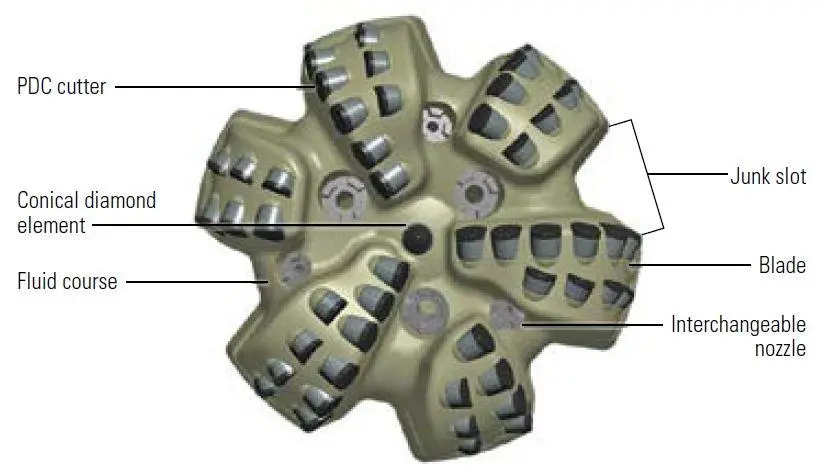
Six-blade PDC bit design: inspect blade spacing, cutter positions, and nozzle openings when assessing a bit's suitability. Image for technical illustration; verify the image provider's commercial-use license before publishing.
- Engineers should consider the following design factors:
- Blade geometry: Blade height, profile, and spacing influence cutting structure support, fluid passage, and the bit's interaction with the formation.
- Cutter size: Larger cutters can provide greater cutting capacity in suitable formations, while smaller cutters or a mixed-size arrangement may offer advantages in selected high-load or abrasive applications.
- Cutter placement: Radial and axial positioning determines how individual cutters share the workload and how much rock each cutter removes.
- Cutter exposure and back-rake angle: These influence aggressiveness, torque response, durability, and resistance to impact damage.
- Gauge protection: Appropriately placed gauge cutters and wear-resistant components help maintain hole diameter and reduce the risk of excessive wear along the borehole wall.
The cutter grade matters just as much as the geometry. Softer formations may favor efficient, aggressive shearing, while abrasive or interbedded formations often require a stronger emphasis on wear resistance, impact tolerance, and thermal stability.
Hydraulic design and hole cleaning
Hydraulics are frequently overlooked when drilling performance is evaluated. Even an efficient cutting structure cannot maintain its expected ROP if cuttings remain beneath the bit or accumulate around the blades.
A custom design should account for nozzle placement, nozzle sizing, flow distribution, pressure drop, available pump capacity, and drilling-fluid properties. The goal is to direct sufficient fluid toward the cutting structure while maintaining effective cuttings transport from the bottom of the hole.
Poor hydraulic performance can cause several problems:
- Recutting of previously removed rock.
- Increased friction and heat around the cutters.
- Localized accumulation of cuttings and reduced bit-to-rock contact.
- Higher pressure losses or inefficient use of available pump power.
Hydraulic design must match both the bit and the drilling system. Increasing flow rate without checking pump limits, erosion risk, pressure losses, and annular cleaning requirements is not a reliable optimization strategy.
In horizontal wells, this issue becomes especially important because cuttings can settle along the lower side of the borehole. Bit nozzle design must work alongside the drilling-fluid program, annular velocity, and circulation practices to support effective hole cleaning.
Matching WOB, RPM, torque, and ROP
Custom bit geometry cannot compensate for unsuitable operating parameters. Weight on bit (WOB), rotary speed (RPM), flow rate, torque, and vibration should be monitored together.
Excessive WOB can overload cutters, increase torque, and accelerate mechanical damage. Insufficient WOB may prevent the cutters from penetrating the formation efficiently. Similarly, increasing RPM can improve penetration under suitable conditions but may increase frictional heat and vibration when the cutting structure is poorly matched to the formation.
A practical optimization process includes:
- Establish a baseline. Review offset-well records, formation descriptions, previous bit runs, dull grades, and available MWD data.
- Set an appropriate operating window. Use the bit manufacturer's recommendations and the limits of the motor, rotary system, drill string, and well program.
- Monitor drilling response. Track ROP, torque, standpipe pressure, vibration, and changes in WOB and RPM.
- Adjust systematically. Change operating parameters in a controlled manner so that improvements can be distinguished from formation changes.
- Review the dull condition. Inspect the cutters, blades, and gauge after the run to identify whether wear, impact, thermal damage, or another mechanism limited performance.
When drilling through changing lithology, operators should reassess the operating window rather than maintaining one set of parameters throughout the entire interval.
Calculate the value of saved rig time
The economic benefit of a custom bit can be evaluated using the total cost of drilling the section.
A practical comparison should include bit purchase price, drilling hours, tripping time, other associated operating expenses, and the footage completed per run. A customized bit may cost more initially but still deliver a lower total cost if it reduces drilling time or avoids an unplanned trip.
For a simple illustration, if a drilling operation saves six rig hours and the applicable rig spread cost is $5,000 per hour, the gross time-related saving would be $30,000 before accounting for additional costs or other operational effects. This is an illustrative calculation, not a reported customer result.
The relevant question is therefore not whether a customized bit is cheaper to purchase, but whether its performance reduces the total cost of completing the interval under comparable drilling conditions.
3. Field Application and How Hainaisen Supports Custom Bit Selection
An illustrative field scenario: abrasive sandstone in a directional well
Consider a drilling contractor working in a Middle Eastern field where a directional well passes through interbedded shale and abrasive sandstone. The existing bit initially delivers acceptable ROP in the softer intervals, but penetration slows as the well enters the more abrasive section. Torque fluctuations become more frequent, and cutter wear limits the footage completed before the next trip.
The drilling team reviews the available operating records and identifies three areas for improvement: insufficient resistance to abrasive wear, inconsistent cutting response across formation boundaries, and the need to maintain reliable hole cleaning.
Rather than simply increasing WOB, the team evaluates a customized PDC design with a revised cutter grade, improved cutter placement, and a blade configuration suited to the expected formation. Gauge protection is also reviewed to support borehole diameter retention. Nozzle selection is checked against the available pump capacity and the requirements of the drilling-fluid system.
During the next run, the team monitors torque, ROP, vibration, and hydraulic indicators, making adjustments within the approved operating window. The final dull inspection is then used to assess whether the revised cutting structure addressed the original wear mechanism.
This is an illustrative engineering scenario, not a verified customer case or a claim of measured performance improvement. Actual results would depend on the formation, well trajectory, drilling assembly, fluid properties, and execution of the operating program.
The main lesson is that effective customization begins with identifying why the existing bit underperformed. A change in blade count alone may not solve a problem caused by cutter-grade selection, poor hydraulics, excessive vibration, or unsuitable drilling parameters.

Drilling rig operations provide the context for evaluating footage per run, tripping time, and total drilling costs. Photo: Emengich, Wikimedia Commons, CC BY-SA 4.0.
Why consider Hainaisen for customized PDC drill bits?
Hainaisen supplies drilling tools for oil and gas, mining, and water well applications. For projects where formation variability or operating conditions create recurring performance problems, a formation-based design review is more useful than selecting a bit by blade count alone.
Hainaisen can help customers evaluate customized PDC bit designs according to the intended hole size, lithology, drilling method, and expected operating conditions.
Relevant considerations include:
- PDC cutter technology: Cutter selection should reflect the balance of wear resistance, impact tolerance, thermal stability, and cutting efficiency required by the application.
- Customized bit geometry: Blade configuration, cutter size, cutter layout, and gauge protection can be considered together to suit the target formation.
- Hydraulic requirements: Nozzle arrangement and available flow capacity should be assessed to support efficient cleaning without exceeding system limitations.
- Stable product quality: Consistent manufacturing and inspection practices help maintain dimensional accuracy and product repeatability.
- Strict quality control: Appropriate checks of materials, dimensions, and finished-product condition support dependable supply.
- Formation-based recommendations: Selection should account for offset-well performance, expected formation changes, drilling-system limitations, and the project's operating priorities.
- Professional technical support: Clear communication about operating conditions, failure observations, and performance targets helps narrow down suitable design options.
- Export experience and responsive communication: These are valuable for international buyers coordinating specifications, production requirements, and delivery schedules across different time zones.
For customers considering a 6-Blade PDC Drill Bit, Hainaisen recommends starting with the actual drilling problem rather than assuming that a particular blade configuration is universally suitable. A six-blade design may be worth evaluating when stability and cutter support are priorities, while other configurations may be more appropriate when aggressive cutting action or greater hydraulic openness is required.
Before requesting a quotation, buyers should provide the bit diameter, target formation, well type, drilling assembly, typical WOB and RPM, available flow rate, previous bit performance, and any known failure or wear patterns. Photographs and dull-grade records can also help clarify the cause of premature failure.
The best bit is the one that delivers the right balance of penetration rate, durability, borehole quality, and total operating cost for the intended interval. With clear application data and a disciplined selection process, Hainaisen can help drilling contractors assess suitable bit configurations and make more informed purchasing decisions.
FAQ
1. What type of PDC bit is best for abrasive sandstone?
A bit for abrasive sandstone should prioritize wear-resistant cutters, suitable cutter support, effective cooling, and reliable cuttings removal. The final design depends on rock strength, mineral content, impact loading, and the drilling system.
2. How does blade count affect drilling efficiency?
Blade count influences cutter-load distribution, cutting structure support, hydraulic space, and stability. More blades can improve support in some applications, but excessive restriction of fluid channels may impair hole cleaning. The optimum configuration depends on the formation and operating conditions.
3. Can a PDC drill bit be customized for horizontal drilling?
Yes. Customization may address cutter layout, torque response, gauge protection, hydraulic performance, and directional requirements. The design must also be compatible with the motor or rotary steerable system and the planned drilling parameters.
4. Which drilling parameters have the greatest influence on ROP?
WOB and RPM are major influences on penetration rate, while flow rate and hydraulic performance affect cuttings removal and thermal conditions. Their effects depend on formation properties, bit geometry, and the capabilities of the drilling assembly.
5. How can operators extend PDC bit life?
Use a formation-appropriate cutter grade, avoid excessive cutter loading, monitor torque and vibration, maintain effective hole cleaning, and operate within the Manufacturer's recommended limits. Reviewing the bit's dull condition after each run helps identify recurring failure mechanisms.
6. Is a customized drill bit always more economical than a standard design?
No. Customization is worthwhile when the expected reduction in drilling time, premature wear, or tripping costs outweighs the additional design or procurement expense. The decision should be based on comparable operating data and total section cost.
About the Author
Daniel Mercer is a drilling technology writer and bit-selection consultant focused on fixed-cutter drilling systems, directional well performance, and drilling-cost optimization. His work examines how cutter technology, blade geometry, hydraulic design, and operating parameters influence bit durability and footage per run across oil and gas formations.
References
1. Society of Petroleum Engineers (SPE) — Journal of Petroleum Technology. “Reducing Frictional Heat in Hard/Abrasive Formations Improves Drilling Efficiency.” Discusses cutter wear, frictional heat, and performance in abrasive formations.
https://jpt.spe.org/reducing-frictional-heat-hardabrasive-formations-improves-drilling-efficiency
2. NOV — ReedHycalog. “ION+ Premium Drill Bit PDC Cutter Technology.” Technical information on application-specific cutter grades, thermal stability, impact resistance, and cutter placement optimization.
https://www.nov.com/products/ion-plus-pdc-drill-bit-cutter-technology
3. Society of Petroleum Engineers (SPE). “Enhancing Drilling Response and Improving ROP on PDC Bits by Utilizing 1-in. Diameter Cutters.” SPE-205717-MS, presented at the SPE/IATMI Asia Pacific Oil and Gas Conference and Exhibition, 2021. Examines cutter size, drilling response, ROP, and directional control.
https://onepetro.org/SPEAPOG/proceedings-abstract/21APOG/21APOG/D031S024R002/470161
4. Journal of Petroleum Engineering, Wiley Online Library. “An Integrated Approach for Drilling Optimization Using Advanced Drilling Optimizer.” Discusses the relationship between bit design, WOB, RPM, hydraulics, and drilling performance.
https://onlinelibrary.wiley.com/doi/10.1155/2015/281276
5. Drilling Contractor. “Optimizing ROP through automation.” Explains the use of drilling mechanics data and operating-parameter control to improve ROP while maintaining wellbore quality.
https://drillingcontractor.org/optimizing-rop-through-automation-2-10696