




What Drill Bit Should You Use for Basalt?
Contact Hainaisen
Email: hainaisen@hnsdrillbit.com
Tel: +86 17791389758
Choosing the right mining drill bit for basalt depends on the rock's compressive strength, abrasiveness, fracture characteristics, and the drilling method being used. Basalt is a dense volcanic rock that can be extremely difficult to penetrate, particularly when it contains hard mineral crystals or occurs in massive, relatively unfractured formations. For most demanding basalt drilling applications, a high-impact-resistant PDC bit or a suitable tungsten carbide insert (TCI) roller cone bit should be considered, depending on the drilling equipment and formation conditions. In particularly hard, abrasive, and fractured ground, diamond-enhanced cutting structures may also be worth evaluating.
The challenge is that basalt does not behave identically at every drilling site. Fresh massive basalt can require substantial cutting force, while weathered or fractured basalt may produce irregular loads, vibration, and sudden changes in penetration resistance. A bit that performs well in one basalt formation may experience rapid wear or structural damage in another.
For mining contractors, quarry operators, and drilling engineers, the selection process should consider cutter technology, bit stability, hydraulic performance, WOB, RPM, and hole-cleaning efficiency together. This guide explains which bit designs are suitable for different basalt conditions and how to improve drilling performance without unnecessarily increasing operating costs.
1. Understanding Basalt and Its Drilling Challenges
1.1 Why Is Basalt Difficult to Drill?
Basalt forms when lava cools and solidifies, creating a fine-grained volcanic rock with a relatively dense structure. Its mechanical properties vary according to mineral composition, cooling history, weathering, and the presence of fractures.
Fresh basalt can have high unconfined compressive strength, making it difficult to penetrate with conventional drilling tools. Some formations also contain hard mineral grains that increase abrasion and accelerate cutting-element wear.
Several geological characteristics directly affect drilling performance:
High compressive strength: Massive basalt requires substantial energy to break, particularly when the rock is fresh and relatively unfractured.
Abrasive mineral content: Hard mineral constituents can cause progressive wear of carbide buttons, diamond elements, and other cutting surfaces.
Fractured structures: Natural joints and fractures create uneven contact conditions, increasing impact loading and vibration.
Variable weathering: Weathered basalt may be easier to penetrate but can produce unstable borehole walls and irregular cuttings.
Hardness variations: Transitions between massive basalt, volcanic breccia, and softer weathered zones can produce fluctuating drilling resistance.
One important distinction is that high hardness and high abrasiveness are not necessarily the same thing. A basalt formation can be difficult to penetrate because of its strength without necessarily producing the same level of tool wear as a highly abrasive sandstone.
Drilling engineers should therefore evaluate both rock strength and abrasivity instead of selecting a bit based on geological classification alone.
1.2 How Basalt Conditions Affect Bit Performance
Different basalt conditions create different failure mechanisms.
In massive basalt, the main challenge is generating enough force to fracture the rock. A bit with insufficiently robust cutting elements may experience slow penetration, excessive vibration, or premature structural damage.
In fractured basalt, the problem changes. The cutting structure repeatedly encounters different levels of resistance, which can create uneven loading across the bit face.
Common operational problems include:
Chipped or broken carbide inserts.
Premature wear of diamond cutting elements.
Increased torque fluctuations.
Reduced penetration rate.
Excessive vibration and bit bouncing.
Gauge wear and loss of hole diameter.
Poor cuttings removal in fractured sections.
Bit stability is particularly important when drilling through alternating massive and fractured basalt. A highly aggressive cutting structure may initially deliver good penetration but become vulnerable to impact damage when the formation changes.
1.3 Which Drilling Methods Are Commonly Used?
The correct bit depends partly on the drilling equipment and the purpose of the hole.
Drilling application | Common bit type | Typical advantage |
|---|---|---|
Open-pit mining blast holes | DTH hammer button bit | High impact energy and effective hard-rock penetration |
Large-diameter rotary drilling | TCI roller cone bit | Robust crushing action and suitability for hard formations |
Quarry and bench drilling | DTH or top-hammer button bit | Effective drilling in hard, fractured rock |
Geothermal and deep hard-rock wells | Specialized PDC, conical diamond element, or roller cone bit | Application-specific cutting and durability |
Geological exploration | Diamond-impregnated core bit | Continuous core recovery in hard formations |
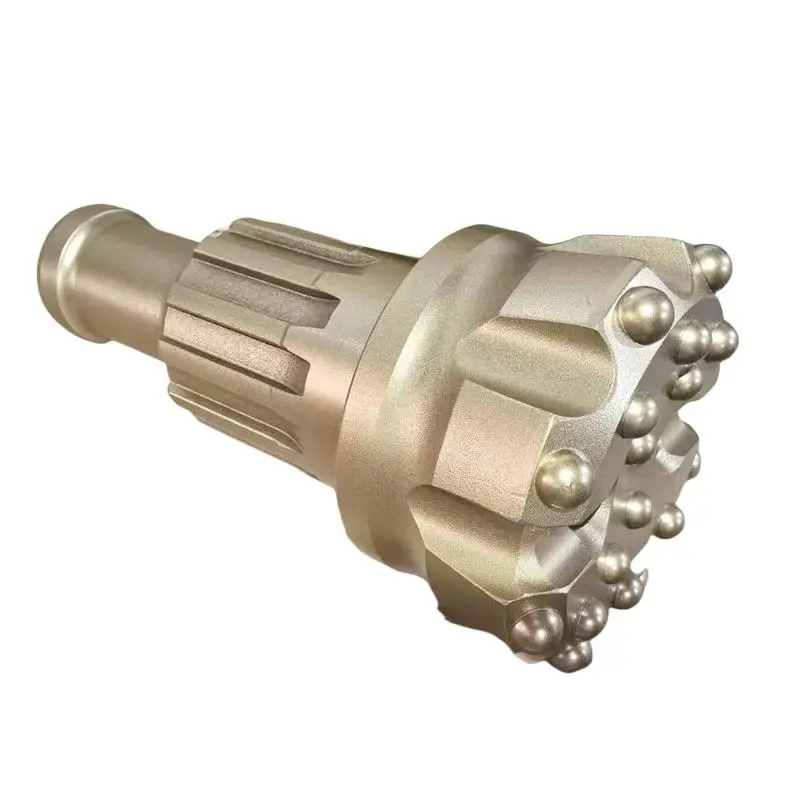
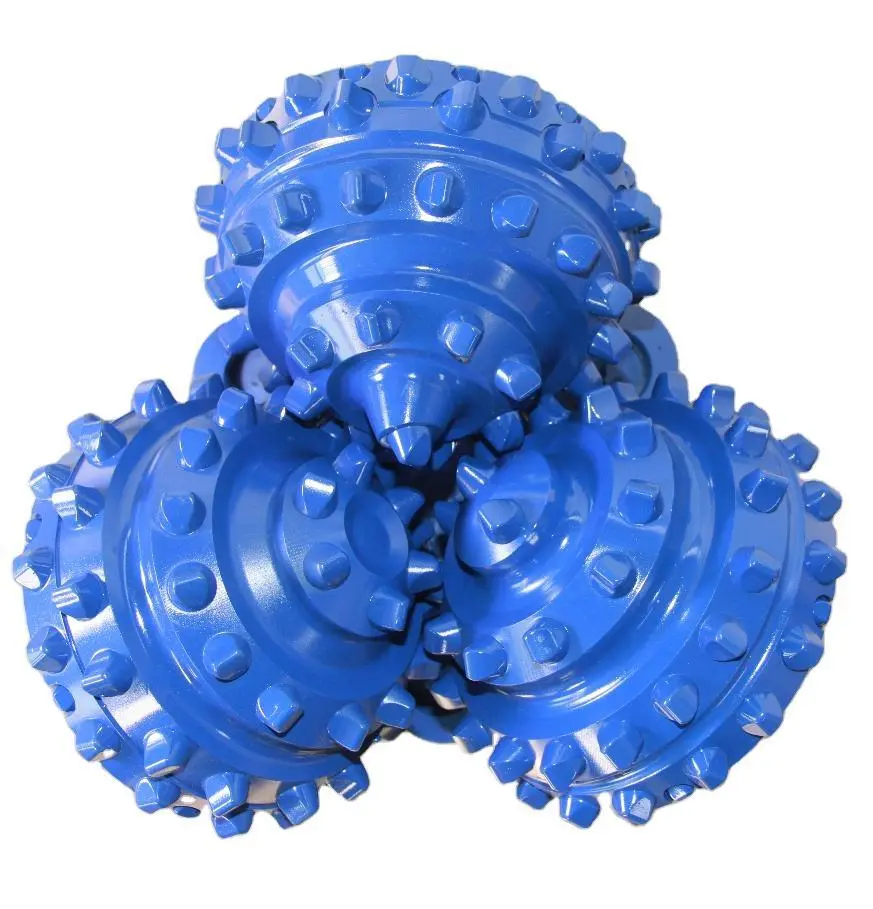
The distinction matters because a blast-hole drilling contractor and a geothermal drilling operator do not necessarily need the same cutting technology.
For example, DTH hammer drilling uses repeated impact energy to break hard rock. Rotary drilling with a roller cone bit relies on crushing and chipping, while fixed-cutter diamond tools remove rock through shearing or localized fracture mechanisms.
For massive, hard basalt in conventional mining blast-hole operations, a robust DTH button bit or a properly selected hard-formation TCI roller cone bit is often a sensible starting point. Specialized diamond-based designs should be evaluated when the drilling method and formation conditions support their use.
2. How to Choose the Right Drill Bit for Basalt
2.1 DTH Hammer Bits: A Strong Option for Mining Blast Holes
For open-pit mining and quarry operations, down-the-hole (DTH) hammer drilling is widely used in hard rock because the hammer transfers impact energy directly to the bit.
A DTH button bit typically uses tungsten carbide inserts arranged across its face. These inserts penetrate and fracture the formation through repeated impact.
For basalt drilling, the following features deserve attention:
Carbide button geometry
Spherical buttons offer strong impact resistance and are commonly used in hard, abrasive formations.
Ballistic buttons provide more aggressive penetration but may be more vulnerable to damage under severe impact conditions.
Parabolic buttons offer a balance between penetration efficiency and wear resistance in suitable applications.
The appropriate button profile depends on the rock structure, drilling equipment, and operating parameters.
Button distribution
The face layout should distribute impact loads effectively. Poor button positioning can cause uneven wear, localized stress, and reduced penetration efficiency.
Gauge protection
Gauge buttons maintain hole diameter and protect the outer cutting structure. This is particularly important in fractured basalt, where uneven rock contact can accelerate gauge wear.
For mining contractors drilling relatively consistent massive basalt, a suitable DTH hammer and button-bit combination can provide reliable impact-based rock fragmentation.
2.2 TCI Roller Cone Bits for Large-Diameter Basalt Drilling
When drilling large-diameter blast holes using rotary equipment, a tungsten carbide insert roller cone bit is another practical option.
Unlike a fixed-cutter design, a roller cone bit uses rotating cones fitted with carbide inserts. As the cones rotate under WOB, the inserts crush and chip the rock.
For hard basalt, selection should focus on:
Short, strong carbide inserts: These provide structural support under high compressive loading.
Robust cone construction: The cones and bearings must withstand sustained drilling loads.
Appropriate bearing protection: Bearing reliability affects operating life and the risk of premature bit failure.
Gauge protection: Strong outer-row inserts help maintain hole diameter.
Suitable IADC classification: The selected bit should match the formation hardness and operating conditions.
The IADC Drilling Manual explains that hard-formation roller cone designs generally use shorter, stronger, and more closely spaced inserts to withstand higher loading and promote crushing rather than aggressive scraping.
For basalt, the exact insert arrangement should be based on formation strength, abrasiveness, and the rotary rig's operating capabilities.
2.3 When Should Diamond-Based Cutting Technology Be Considered?
PDC and other diamond-based cutting technologies can be useful in selected hard-rock applications, but conventional flat PDC cutters are not automatically the best choice for every basalt formation.
In massive, highly fractured, or impact-intensive basalt, conventional cutters may experience excessive mechanical loading.
Specialized designs can help address this challenge.
Conical diamond elements (CDE) use a three-dimensional diamond cutting geometry rather than relying exclusively on a conventional flat cutting face. Their concentrated contact area can generate high local stresses, helping fracture hard rock while improving resistance to certain impact and wear conditions.
Diamond-impregnated bits are another option for hard and abrasive rock, particularly in geological exploration and core drilling. Diamond particles embedded in a metallic matrix gradually expose new cutting edges as the matrix wears.
The selection depends on the drilling objective:
Technology | Most relevant application | Main consideration |
|---|---|---|
Conventional PDC | Suitable hard-rock intervals with manageable impact loading | Cutter impact resistance |
Conical diamond elements | Hard, abrasive volcanic formations | Concentrated point loading and structural durability |
Diamond-impregnated | Hard-rock core drilling | Matrix wear rate and diamond exposure |
TCI roller cone | Rotary hard-rock drilling | Insert durability and bearing reliability |
DTH carbide button bit | Mining blast holes in hard basalt | Impact resistance and hammer compatibility |
A technical paper published by SLB discusses the use of conical diamond element technology in abrasive volcanic formations in Indonesia. The design was developed to address high compressive strength and cutter damage associated with conventional drilling approaches.
斯伦贝谢+1
This demonstrates an important point: specialized diamond technology can be a viable alternative to conventional roller cone drilling when the formation and operating conditions justify it.
2.4 Optimize WOB, RPM, and Drilling Parameters
Even a suitable bit can perform poorly when operating parameters are inappropriate.
For rotary drilling in basalt, WOB and RPM should be adjusted according to formation strength, cutting structure, and the equipment's operating limits.
The main parameters to monitor include:
Weight on bit (WOB)
Insufficient WOB may prevent effective rock penetration. Excessive WOB can overload inserts or cutters, increase vibration, and accelerate structural wear.
Rotational speed (RPM)
Higher RPM may improve drilling efficiency under suitable conditions, but excessive speed can increase wear and thermal loading. Hard basalt generally requires careful control rather than simply maximizing rotational speed.
Torque
Sudden torque fluctuations can indicate changing formation resistance, bit instability, or an unsuitable cutting structure. Monitoring torque helps identify problems before they cause serious damage.
Rate of penetration (ROP)
A declining ROP may indicate dull cutting elements, excessive vibration, or changing geological conditions. It should be assessed alongside WOB, RPM, and torque rather than used as an isolated performance indicator.
Flushing flow rate
Adequate air or drilling-fluid circulation removes rock fragments and helps prevent cuttings from accumulating around the bit. In DTH drilling, the flushing system must also meet the hammer's air requirements.
2.5 A Documented Case: Diamond Element Drilling in Volcanic Formations
A useful industry example comes from a geothermal drilling project in West Java, Indonesia, described in an SLB technical paper.
The drilling operation encountered challenging volcanic formations containing silicified andesitic tuff, breccia, quartz, chert, and pyrite. Conventional drilling through these materials had experienced difficulties associated with high rock strength and impact-related cutter damage.
The operator evaluated a specialized conical diamond element bit as an alternative to conventional TCI roller cone technology.
The reported results included:
The technology was used in 12.25-inch and 9.875-inch hole sections.
The respective drilled intervals were approximately 660 m and 799 m.
The bits demonstrated the capability to exceed 50 m/h ROP, although actual ROP was controlled at approximately 20–30 m/h because of hole-cleaning considerations.
The reported ROP improvement was approximately 20% compared with offset wells drilled using TCI bits.
The technical paper reported an estimated drilling-cost reduction of approximately US$398,000.
These results are reported for the specific volcanic formations and operating conditions in the study. The formations were not identified as basalt, so the figures should not be treated as guaranteed basalt drilling performance.
The practical lesson is that hard volcanic formations sometimes require a specialized cutting structure rather than simply a stronger conventional bit. Formation analysis, cutter geometry, hydraulic performance, and operating parameters must be considered together.
3. How Hainaisen Helps Customers Select Basalt Drilling Solutions
3.1 Formation-Based Product Recommendations
Choosing a mining drill bit for basalt should begin with the actual drilling conditions, not simply the rock name or hole diameter.
Before recommending a product, several technical details should be evaluated:
Rock characteristics: Is the basalt fresh, weathered, massive, fractured, or interbedded with other volcanic materials?
Compressive strength: How much force is required to fracture the formation?
Abrasiveness: Does the mineral composition create excessive cutting-element wear?
Drilling method: Is the project using DTH hammer, rotary drilling, top hammer, or core drilling?
Hole specifications: What are the required hole diameter and drilling depth?
Equipment parameters: What WOB, RPM, torque, and flushing capacity are available?
Service-life requirements: Is the priority maximum penetration rate, longer bit life, or reduced drilling cost per meter?
These details help determine whether conventional PDC technology, a specialized diamond cutting structure, or another hard-rock drilling solution is more appropriate.
3.2 Why Consider Hainaisen?
Hainaisen supplies drilling products for international customers working in mining, oil and gas, water well drilling, and other demanding rock-drilling applications.
For customers dealing with hard formations such as basalt, Hainaisen focuses on several important areas:
Stable product quality and strict quality control
Manufacturing consistency is essential for maintaining predictable product dimensions, material properties, and cutting performance. Hainaisen emphasizes quality control throughout production to support reliable product supply.
PDC cutter technology
Cutter quality influences wear resistance, impact performance, and the durability of the cutting structure. Appropriate cutter specifications should be selected according to the expected geological conditions.
Customized product design
Different basalt formations require different approaches. Hainaisen can discuss product specifications and customized configurations according to drilling requirements, including cutter selection, dimensions, and application conditions.
Formation-based technical recommendations
A design suitable for weathered basalt may not be appropriate for fresh, massive volcanic rock. Hainaisen considers geological information and drilling requirements when discussing suitable products with customers.
International export experience and responsive communication
For overseas mining contractors, clear technical communication and efficient specification confirmation help reduce misunderstandings during procurement. Hainaisen supports international customers through product discussions, customized requirements, and application-related technical assistance.
3.3 What Information Should You Provide Before Ordering?
To obtain a more accurate product recommendation, customers should prepare the following information:
Required information | Why it matters |
|---|---|
Rock type and geological report | Identifies hardness and formation variations |
Hole diameter | Determines product dimensions |
Drilling depth | Helps assess operating requirements |
Drilling method | Determines the appropriate cutting technology |
Equipment model | Confirms compatibility |
Previous bit performance | Helps identify wear and failure mechanisms |
Target service life | Establishes performance priorities |
For example, a contractor drilling 150 mm blast holes in massive basalt with a DTH hammer will have different requirements from a geothermal operator drilling a deep volcanic formation with a rotary drilling assembly.
The best recommendation is the one that matches the actual formation, drilling equipment, and operating conditions.
Hainaisen aims to support customers with stable product quality, customized specifications, professional technical communication, and drilling solutions for different geological applications.
For mining contractors looking to improve drilling efficiency in hard rock, working with a supplier that understands cutter performance and formation-related requirements can make product selection more practical and predictable.
FAQ
1. What type of drill bit is best for drilling basalt?
For open-pit mining blast holes, DTH hammer button bits and hard-formation TCI roller cone bits are common choices. Specialized conical diamond element or impregnated diamond bits may be suitable for particular hard-rock and exploration applications.
2. Can PDC bits drill through hard basalt?
Yes, specialized PDC designs can drill certain hard volcanic formations. However, conventional flat PDC cutters may be vulnerable to impact damage in highly fractured or extremely hard basalt. Cutter geometry and impact resistance should be evaluated carefully.
3. Are DTH hammer bits better than roller cone bits for basalt?
Neither is universally better. DTH bits use impact energy and are particularly useful for hard-rock blast-hole drilling. Roller cone bits use crushing and chipping action and are suitable for many large-diameter rotary drilling applications. Equipment compatibility and formation conditions determine the better option.
4. How can I extend drill bit life in basalt formations?
To improve service life:
Select carbide or diamond cutting elements appropriate for the formation.
Avoid excessive WOB and unsuitable RPM.
Maintain sufficient flushing and hole cleaning.
Monitor torque and vibration.
Inspect gauge wear and cutting-element damage.
Adjust drilling parameters when formation conditions change.
5. Does basalt hardness affect drilling speed?
Yes. Higher compressive strength generally increases the energy required to fracture rock, which can reduce ROP. Fractures, weathering, mineral composition, and drilling technology also influence penetration performance.
6. Can Hainaisen provide customized drilling products for basalt?
Hainaisen can discuss customized product specifications and formation-based recommendations for different drilling applications. Customers should provide their hole dimensions, drilling method, equipment details, and available geological information to support product selection.
About the Author
Michael Anderson is a drilling technology researcher and technical writer specializing in hard-rock drilling, mining equipment, and advanced cutting materials. His work covers PDC cutter applications, tungsten carbide drilling components, geological formation analysis, and drilling performance optimization. He focuses on practical engineering considerations for mining contractors, quarry operators, and international drilling equipment buyers.
References
1. Tipples, R., Ben-Fayed, M., Brand, P., Gonzalez Luis, R. A., and Keshiyev, S. (2026). Drill Bit Considerations for Hard Rock Drilling in Newberry, Oregon. Proceedings of the 51st Stanford Geothermal Workshop.
https://pangea.stanford.edu/ERE/db/IGAstandard/record_detail.php?id=38411
2. SLB. (2017). Drilling Optimization in Hard and Abrasive Geothermal Volcanic Rock Using Innovative Conical Diamond Element Bit.
https://www.slb.com/resource-library/technical-paper/geothermal/2017-other-stingblade
3. Zhang, G., Thuro, K., Konietzky, H., Menschik, F. M., Käsling, H., and Bayerl, M. (2022). In-situ Investigation of Drilling Performance and Bit Wear on an Electrical Drill Hammer. Tunnelling and Underground Space Technology, 122, 104348.
https://doi.org/10.1016/j.tust.2021.104348
4. International Association of Drilling Contractors (IADC). IADC Drilling Manual – Bit Design and Classification.
https://iadc.org/
5. John, G., Baudouin, N., Teasdale, P., and Davis, R. (2014). Innovative Dual-Diameter PDC Bit Design Provides Unique Solution to Successful Drilling of Challenging Volcanic Interval. IADC/SPE Drilling Conference, SPE-168006-MS.
https://doi.org/10.2118/168006-MS
6. Okubo, S., Ota, A., Akiyama, M., Fukui, K., and Nishimatsu, Y. (1997). Abrasivity of Rock and Bit Wear in Drilling. Journal of MMIJ, 113(5), 325–332.
https://doi.org/10.2473/shigentosozai.113.325